Wood-fired hot tub or sauna? What to choose for your garden — and when both make sense
They are sometimes treated as two versions of the same idea. They differ in preparation time, site requirements, maintenance and what they do for your body. Here is a step-by-step comparison, with figures.
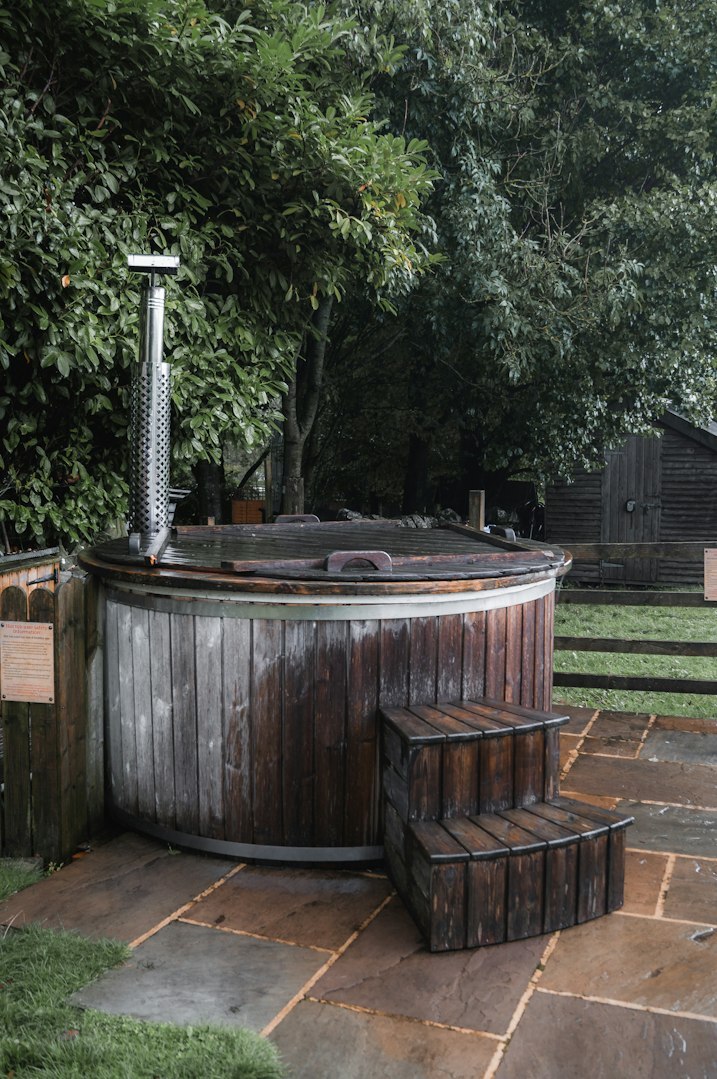
A wooden hot tub with a heater — warm-water bathing in the open air.
“Hot tub or sauna?” comes up in roughly half our quote enquiries. Almost always, the real question is: how much work will this involve day to day? Both are enjoyable, but their daily upkeep is very different.
1. How they really differ
Sauna means hot, dry air — usually 70–100 °C with humidity in the low teens. Heat reaches your body through the air and radiation, giving it time to react: sweating starts after a few minutes and does the hard work.
Heated hot tub means hot water, usually 36–40 °C. Water transfers heat more than twenty times as effectively as air, so despite the much lower temperature your body warms up faster. This leads to a simple safety rule: spend less time in a hot tub than you might instinctively want to.
In practice, a sauna is an intense, brief experience; a hot tub is gentler and more leisurely. Sauna bathing is a ritual in rounds. A hot tub is somewhere to sit in the water with someone you want to talk to.
2. Preparation time — the most underestimated difference
After a year, this is often the difference that determines how often you actually use it:
- Sauna with an electric heater: 40–60 minutes in summer, 60–90 in winter. With a timer, very little planning is needed.
- Hot tub with an internal or external wood-burning heater: 2–4 hours for a typical capacity of around 1,000–1,500 litres, and as much as 5–6 hours in freezing weather. You need to keep adding wood during that time.
- Hot tub with an electric heater and a good insulated cover: kept at temperature continuously and always ready — but then you pay for maintaining the heat rather than for each session.
Customers who choose only a wood-fired hot tub tend to use it less often than they expected, usually for the same reason: a four-hour warm-up means deciding in the morning, rather than at eight in the evening. If spontaneity matters, consider a sauna or an electrically heated hot tub.
3. Weight and ground conditions — the surprising detail
A 1,200-litre hot tub holds 1,200 kilograms of water alone. Add the tub itself and four people, and you are looking at around two tonnes concentrated on just a few square metres. This is not a load you can place anywhere on the lawn.
- A hot tub needs a firm, level base — a concrete slab, well-compacted aggregate or decking with a verified load capacity.
- Putting it on ordinary timber decking without checking the structure can cause the joists to bend.
- A sauna is much lighter and spreads its weight over the whole footprint, so the ground requirements are less demanding — although levelling is just as important.
We cover site preparation in a separate article: preparing a site for your garden sauna.
4. Looking after the water — the least discussed subject
This is where the real difference in daily use lies. A sauna needs little upkeep apart from sweeping, ventilation and occasional timber treatment. A hot tub contains water, and that water needs looking after.
- Without filtration or water treatment: the water is suitable for 2–5 bathing sessions, then needs changing. Filling 1,200 litres takes time and costs money.
- With filtration and chemicals (chlorine, bromine or active oxygen, plus pH checks), the same water can last for weeks. In return, you take on a weekly routine of testing and dosing, much like a small swimming pool.
- Drainage needs planning before you position the tub. Releasing 1,200 litres in one place can wash out the lawn or undermine a foundation.
Water expands by around 9% when it freezes and can split pumps, hoses and filters. In winter, either keep the tub above freezing or empty it completely, including all the plumbing. Read more in our article about using a sauna in winter.
5. A third option: a cold plunge tub
This comparison often overlooks an option that suits many people best: a cold plunge tub — a cold bath beside the sauna, without a heater or water heating.
Its advantage is simple and practical: there is no need to heat it up. No warm-up time, no energy cost and no adding wood. Cold water is ready exactly when you step out of the hot sauna, and that contrast is central to sauna bathing.
You still need to change or treat the water, although it deteriorates more slowly at a lower temperature. Find the models in our store: a cold plunge tub.
A sauna provides heat. A cold plunge tub provides contrast. A heated hot tub gives you an evening together.
6. How much does it cost?
Purchase prices depend on size, timber and equipment. You can find current prices in our store, and we prepare individual quotes free of charge. It is also worth comparing running costs, because these can come as a surprise:
- Electric sauna: around 8–14 kWh per session, including warm-up and an hour of use, with a 6–9 kW heater in a well-insulated cabin.
- Wood-fired hot tub: roughly 15–25 kg of wood for one warm-up, depending on capacity, season and the quality of the cover.
- Electrically heated hot tub kept warm continuously: costs are calculated monthly rather than per session, and depend on insulation and the insulated cover.
- Water and chemicals: allow for filling and water-treatment products with a hot tub; a sauna has no such cost.
7. Comparison table
| Garden sauna | Heated hot tub | Cold plunge tub | |
|---|---|---|---|
| Temperature | 70–100 °C, dry air | 36–40 °C, water | Ambient temperature or lower |
| Preparation time | 40–90 min | 2–6 hours | None |
| Number of people | 2–8, depending on the model | 4–8 | 1–2 |
| Ground conditions | Level base, moderate requirements | Firm base, load of up to around 2 t | Firm base, lower load |
| Looking after the water | None | Water changes or filtration and chemicals | Water changes or filtration |
| In winter | No restrictions | Needs frost protection | Needs frost protection |
| Best for | Recovery and a sauna ritual | Socialising and conversation | Cooling down after a sauna |
8. When both make sense
A sauna and a cold plunge tub work as one set — the temperature contrast is central to the whole practice. A typical sequence is:
- 8–15 minutes in the sauna, until you are sweating freely.
- A few minutes in the fresh air — this matters; do not shorten this stage in winter.
- A brief dip in cold water: around fifteen seconds to a minute, no longer.
- Rest and drinking water. Then a second and third round, if you feel like it.
If your dream is a heated hot tub and a sauna, start with the sauna. It is cheaper to run, needs no water maintenance and fits into your daily routine sooner. You can add the hot tub later, once the ground and utility connections are ready.
Hot-to-cold temperature changes place a heavy strain on the cardiovascular system. If you have heart disease or high blood pressure, are pregnant or take medication that affects circulation, consult your doctor. Never combine sauna bathing or cold-water immersion with alcohol.
Frequently asked questions
Which is cheaper to run — a sauna or a hot tub?
A sauna, by a clear margin. It contains no standing water, so there are no refills, chemicals, filtration or frost protection for plumbing to pay for. In practice, the running cost is simply electricity or firewood for each session.
Can a hot tub be installed on decking?
Only after a qualified professional checks the structure’s load capacity. A full tub with people inside puts around two tonnes on a small area, and ordinary garden decking is not designed for that.
How often should I change the water in a hot tub?
Without treatment, after 2–5 bathing sessions. With filtration and controlled chemical treatment — chlorine, bromine or active oxygen, plus pH checks — the water lasts several weeks. The choice comes down to your preference: more frequent refilling or weekly testing and dosing.
Can a hot tub be used all year round?
Yes, and it is particularly enjoyable in winter. The water must either be kept above freezing continuously, or the plumbing must be drained for freezing weather. An insulated cover greatly reduces the cost of maintaining the temperature.
What should I start with if my budget only allows one?
Start with a sauna if recovery, spontaneity and low maintenance costs matter most. Start with a hot tub if you mainly want a place to socialise and spend time in the water with your family. Installing a sauna first and a hot tub later is technically easier, because the hot tub’s connections can be prepared during the first project.
Not sure what would suit your garden best?
Tell us how you imagine using it, and we will suggest what makes sense for your site, budget and daily routine. Advice and quotes are free.
You may also like
A garden sauna in winter — how to use it